
A replacement part may match an old component’s dimensions yet fail to meet the demands of service. For custom iron casting for municipal infrastructure, legacy drawings and material specifications are useful starting points, but the casting must also suit the loads, wear, movement, and environmental exposure it will face in operation.
Restoration records are often incomplete, and selecting a replacement by shape alone can overlook important design and material requirements. Assess the available part evidence alongside actual service conditions, then use those details to guide material selection and design review.
This article explains how to assess replacement-part requirements, compare Gray Iron, Ductile Iron, and Malleable Iron, and prepare a project brief. It also outlines how a foundry technical assessment and sample approval can help move a casting from initial evaluation to a defined production project.
Key Takeaways
- Assess the part’s geometry, interfaces, function, and service conditions before deciding whether a replacement casting is appropriate.
- Compare Gray Iron, Ductile Iron, and Malleable Iron against documented requirements, not appearance alone.
- Use available drawings, CAD files, material records, and sample parts to build a clear project brief for custom iron casting for municipal infrastructure.
- Compare a custom casting with an existing part or standard alternative by considering fit, documentation, quantity, and operating demands.
- Plan technical assessment and sample approval as project checkpoints. Bowmanville Foundry has produced iron castings since 1902 and was the first foundry in Canada to achieve ISO certification, in 1996.
When Does Custom Iron Casting Make Sense for Municipal Infrastructure Restoration?
A replacement part must do more than resemble the component it replaces. Custom iron casting for municipal infrastructure means producing an iron component to project-specific geometry and requirements. Its shape, connection points, and intended function can then be assessed against the equipment or system it must serve. This differs from choosing a standard component simply because its dimensions appear similar.
Restoration work can involve covers, valve bodies, pump housings, and other components used in municipal systems. The municipal castings overview provides context on the range of cast products associated with this field. For a replacement decision, the key question is whether the proposed part will fit and perform under the project’s actual service conditions.
The word “restoration” alone does not establish that a custom casting is suitable. A legacy component may be a candidate when its geometry or interfaces are specific to the installation, or when another replacement route does not address its required function. A technical assessment helps determine whether the part design is feasible and what information remains unresolved before production planning.
What information helps assess a replacement infrastructure part?
Start with the part’s role in the system and the conditions it encounters. Record how it connects to adjacent components, the loads or movement it experiences, and whether moisture, abrasion, or other operating conditions are relevant. Include known failure history, such as where damage occurred and whether the same issue has recurred. These details help distinguish a design requirement from an assumption.
Gather whatever evidence is available, even if the records are incomplete:
- Drawings, specifications, and CAD files showing geometry and required interfaces.
- Photographs, measurements, or a physical sample that help describe the existing part.
- Material records, maintenance notes, and details of known failures or modifications.
Label each detail as confirmed, estimated, or unknown. This gives the project team and foundry engineer a clear basis for review and prevents assumptions from becoming undocumented production requirements.
When should a legacy component receive a technical assessment?
Arrange a technical assessment when drawings are missing, the component has been modified, its failure history raises questions, or service conditions have changed since the original part was selected. Changes in operating duty can affect fit, load requirements, wear resistance, and maintenance access. A familiar shape does not prove that the original design remains appropriate.
Before review, document how the part locates and attaches, the loads it must carry, surfaces subject to wear, and inspection or maintenance needs. A foundry engineer can assess the design’s feasibility using the records and sample evidence provided, identify information gaps, and discuss production considerations. This assessment helps define next steps, while the project team remains responsible for establishing operating requirements.
Match Iron Casting Material to Restoration Conditions
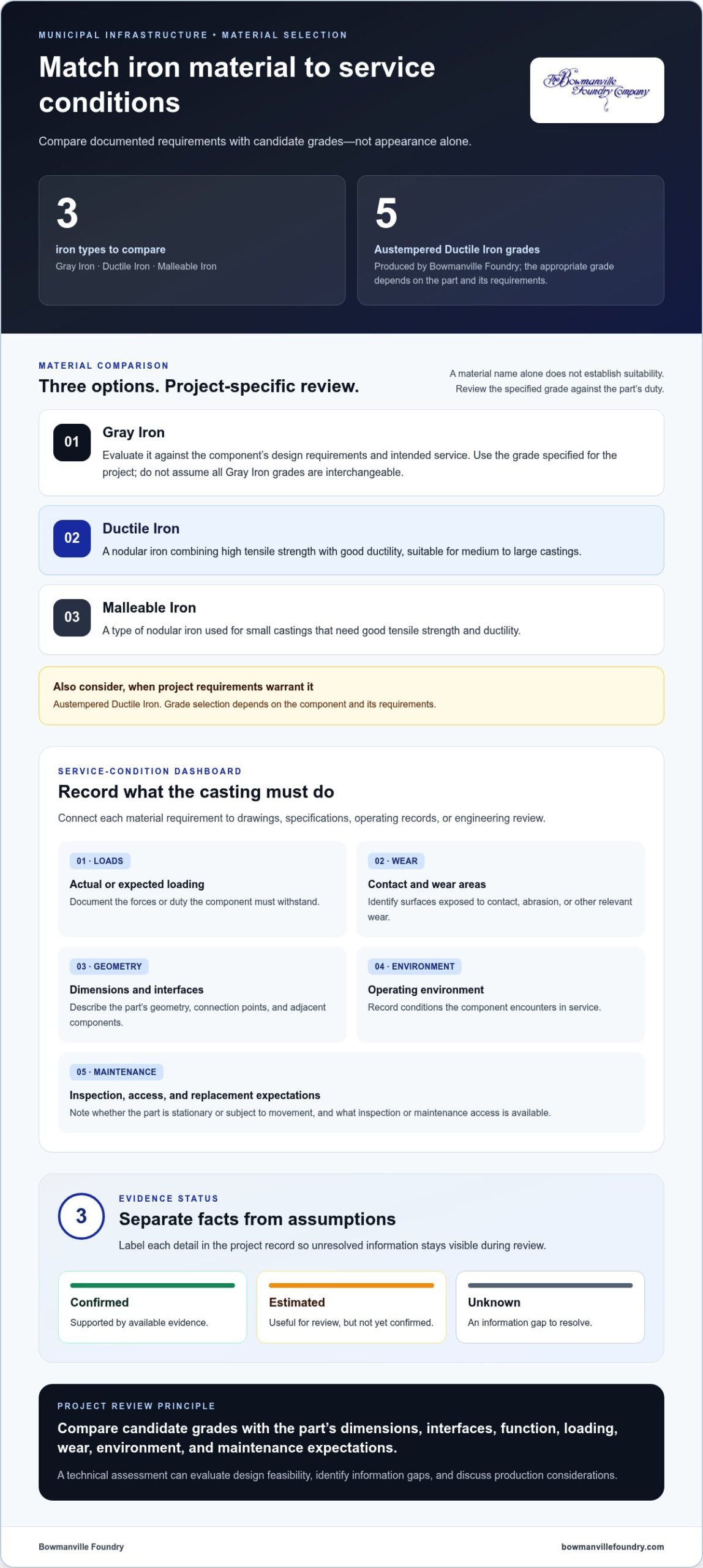
Material selection starts with the part’s job, not a general preference for one iron type. A replacement must suit its function, geometry, loading, wear, operating environment, and maintenance expectations. For custom iron casting for municipal infrastructure, record these conditions and link each material requirement to evidence from drawings, specifications, operating records, or engineering review. A material name alone does not establish that a casting is suitable.
There is no universal grade recommendation for restoration work. Two parts with similar shapes may have different duties, and a component’s demands may change when the system changes. Compare documented requirements with the properties and production considerations of available grades. Keep assumptions visible until they can be evaluated through a project-specific technical assessment.
What distinguishes Gray Iron, Ductile Iron, and Malleable Iron?
Evaluate Gray Iron against the component’s design requirements and intended service. Use the grade specified for the project rather than assuming all Gray Iron is interchangeable. Ductile Iron is a nodular iron that combines high tensile strength with good ductility, suitable for medium to large castings. Malleable Iron is a type of nodular iron used for small castings that need good tensile strength and ductility. These descriptions help frame a comparison, but do not replace grade-level review.
For each candidate, consider how its material requirements relate to the part’s dimensions, interfaces, and function. Tie the material decision to the component specification and a review of service conditions. If the project requirements warrant it, include Austempered Ductile Iron in the evaluation. Bowmanville Foundry produces five grades of Austempered Ductile Iron, but the appropriate grade depends on the part and its requirements.
Which service conditions belong in material selection?
Build a concise record of the conditions that affect the casting in operation. Include actual or expected loading, contact or wear areas, geometry, operating environment, and maintenance expectations. Note whether the part is stationary or subject to movement, how it interfaces with adjacent components, and what inspection or replacement access is available. Clear records keep the engineering review focused on relevant requirements.
- Loading: Document the forces or duty the part must withstand, including any changes from its previous use.
- Wear and contact: Mark surfaces exposed to abrasion, repeated contact, or movement.
- Environment: Record exposure conditions and flag low temperature environments for engineering review.
- Geometry and maintenance: Identify critical interfaces, access requirements, and service practices that affect the design.
Do not infer a material grade from the operating environment alone. Provide the available requirements for review, then assess how candidate grades align with the part’s full function. For help preparing a material review, contact Bowmanville Foundry about a technical assessment and share the project records available.
Custom Casting, Existing Parts, or Adaptation: Compare the Project Routes
A restoration team may consider commissioning a custom casting, reusing or replacing an existing part, or adapting a standard component. None is automatically preferable. The right choice depends on how closely the option matches required geometry, interfaces, function, material requirements, finishing needs, and project constraints. For custom iron casting for municipal infrastructure, compare each route against the same documented criteria instead of treating the original part as the only possible design.
A custom replacement may warrant evaluation when the component has project-specific geometry, attachment points, or interfaces that a standard option may not match. A physical sample can help establish dimensions and form, while reliable drawings, CAD files, and material records may clarify design intent. If key details are missing, record them as open questions for engineering review rather than assuming the existing shape or material should be copied without change.
When might a custom replacement casting merit evaluation?
Consider a custom route when fit depends on a distinctive mounting arrangement, a specific connection to adjacent equipment, or geometry that affects the component’s function. The design still requires review for service conditions and production feasibility. A foundry engineer can assess the available information and identify what needs resolution before production planning, including unclear dimensions, material requirements, or finishing details.
How should buyers compare project requirements objectively?
Apply the same decision factors to every route. The comparison below organizes evidence and questions for technical review; it does not prescribe an outcome. Separate confirmed requirements from assumptions based only on the original part. For more detail on the production route, consult the guide to custom iron casting production.
Route: Custom casting
Evidence: Drawings or CAD files, a physical sample, interface dimensions, material records, required finishing, and expected quantity.
Review questions: Can the proposed geometry be produced? Which details affect fit or function? What design points require approval before production?
Route: Existing part
Evidence: Part identification, condition, measurements, material information, failure history, and confirmation that its interfaces match the installation.
Review questions: Is the part suitable for its intended service? Does its condition or history point to unresolved performance concerns? Are the records sufficient to specify a replacement?
Route: Standard component or adaptation
Evidence: Documented dimensions, connection points, material information, finishing requirements, and any proposed design changes.
Review questions: Does it meet the required fit and function without compromising interfaces? What modifications are needed, and how will those changes be reviewed and approved?
Quantity and approval steps also affect the comparison. Define the expected production quantity and whether sample approval is required before full production begins. An option that appears straightforward on a drawing may raise questions when the team checks installation fit or maintenance access. Bowmanville Foundry’s technical assessment can help evaluate part-design feasibility and clarify project requirements before a production plan is established.
What to Include in a Custom Iron Casting Project Brief
A clear project brief turns scattered records into a reviewable production request. For custom iron casting for municipal infrastructure, organize the information so the foundry can identify the part, understand its function, assess the design, and agree on a sample approval checkpoint before full production. Mark missing details for review rather than filling them in by assumption.
Use these steps to assemble the brief:
- Identify the part. Give it a name or asset reference, describe its function, and state where it fits in the larger system.
- Provide design evidence. Include available drawings, CAD files, specifications, photographs, measurements, or a physical sample. Note the source and revision of controlled documents.
- Describe service requirements. Record operating conditions, loading, wear, maintenance expectations, known failures, and any changes from the part’s previous duty.
- Define geometry and interfaces. Identify critical dimensions, connection points, mating surfaces, and known tolerance requirements. Distinguish specified values from estimates.
- State production assumptions. Give the proposed material, expected quantity, and required finishing. Identify whether machining, heat treating, or surface coating is needed for the finished component.
- Set the approval checkpoint. Describe how the sample will be reviewed, which features must be validated, and who will provide sample approval before full production begins.
Which design and production details should the brief capture?
Make each requirement traceable to its source document or the responsible project decision. If a dimension comes from a worn sample rather than a controlled drawing, label it accordingly. List each required interface and the feature it affects, such as seating, alignment, or attachment. Record proposed material and finishing needs as inputs for technical assessment, not final specifications until they have been reviewed.
How do mold and pattern decisions enter the process?
In sand casting, a two‑half mold is made by joining two compacted sand halves to form the casting cavity. The flask is the metal frame that holds the mold, and mold compaction squeezes sand in the flask to take the pattern’s shape. Where a design requires a hollow section, a core, which is a hardened sand insert, forms that internal geometry. These production choices follow part design review.
Pattern terms also belong in the discussion, but buyers should not prescribe a method without technical review. A matchplate holds multiple patterns for simultaneous production of similar castings. A pattern framing facility is the workshop area where patterns are assembled and prepared for molding. Include production quantity and part geometry in the brief so these considerations can be assessed against the project requirements.
Before release, compare the proposed sample with the agreed drawing or acceptance criteria. Record changes, unresolved dimensions, and finishing requirements so the approved sample represents the intended production part. Bowmanville Foundry provides technical assessment and support from technical or sales engineers. Discuss your casting project brief with Bowmanville Foundry to organize the information for design review.
Select a Foundry Partner and Move the Restoration Casting Forward
A sound foundry relationship connects the project brief to a feasible casting plan. For custom iron casting for municipal infrastructure, assess how the foundry approaches technical review, material selection, quality management, and finishing support. These capabilities help the project team resolve design questions, define production requirements, and plan for the finished component as well as the casting itself.
Bowmanville Foundry has produced iron castings since 1902. It was the first foundry in Canada to achieve ISO certification, in 1996. Its modern, clean, 38,000-square-foot plant produces three grades of Gray Iron, as well as Ductile Iron and Malleable Iron castings. Material grades and production details still need to match each project’s documented requirements.
What manufacturing and quality information supports supplier evaluation?
A quality management system is a structured set of procedures and processes used to support product quality and continuous improvement. For procurement teams, it provides a framework for reviewing how requirements are managed through production. Discuss how the project’s drawings, material requirements, approval criteria, and finishing needs will inform the production plan. A technical or sales engineer can review the part information, identify questions to resolve, and help assess design feasibility.
Consider how casting and finishing requirements can be coordinated. Bowmanville Foundry provides post-processing services, including machining, heat treating, and surface coating. This can support a one‑stop‑shopping model when casting and post-processing are handled together. Specify the operations the finished part needs and include them in the project discussion. Coordinate any logistics requirements as part of the project plan so they are considered alongside production and finishing.
Planning assumptions matter, too. Typical lead times are four to eight weeks depending on current business conditions, and tooling can be produced in two to four weeks. These are planning references, not fixed project commitments; timing depends on the project and current conditions. Discuss the required schedule alongside design review, tooling, production, finishing, and sample approval so the team can plan around the actual sequence.
What are the practical next steps for a project team?
Before requesting a technical assessment, assemble the information available to procurement and engineering. A useful starting package helps the foundry understand both the component and the project’s decision process.
- Collect drawings, CAD files, material records, photographs, and any available sample part.
- Summarize operating requirements, interfaces, known failure history, and proposed material needs.
- State expected quantity, post-processing requirements, target schedule, and sample approval criteria.
- Identify the engineering and procurement contacts responsible for reviewing the design and approving the sample.
With these inputs assembled, discuss design feasibility and project-specific production planning with Bowmanville Foundry’s technical or sales engineers. A technical assessment can help define remaining questions before production proceeds. Contact Bowmanville Foundry about your project to begin the discussion.
Set the Next Restoration Project in Motion
Treat the replacement decision as an opportunity to create a clearer technical record for the next maintenance cycle. When the design basis, confirmed dimensions, material rationale, and sample approval criteria are documented together, the project team has a reference for procurement, installation, and future review. Keep that record with the asset documentation, including approved changes made during assessment. This will not remove every uncertainty from a legacy component, but it makes decisions visible and traceable.
This discipline is useful when custom iron casting for municipal infrastructure is considered alongside reuse or adaptation. The team can document why the selected route addresses the part’s requirements instead of relying on resemblance or inherited assumptions. A clear brief also gives the foundry a practical starting point for technical discussion and helps engineering and procurement stay aligned as project details are resolved.
Begin with the records available, identify the remaining questions, and establish who will review the proposed design and sample. A focused discussion can turn those inputs into practical next steps. Arrange a discussion with Bowmanville Foundry about your restoration casting requirements, and move the project forward with a clear technical basis.
Frequently Asked Questions
Can an existing component be used to assess a replacement casting if drawings are unavailable?
Yes. An existing component can provide useful reference evidence when drawings are missing. A foundry engineer can review its shape and accessible features, but wear, corrosion, or damage may have changed its dimensions. Treat measurements from a used part as observations, not automatically as the original design requirements. Photographs of the part in position, notes on how it connects to surrounding equipment, and records of modifications can help explain details the sample alone cannot show.
Is iron casting suitable for components used in low temperature environments?
Suitability depends on the component’s material requirements and actual operating conditions. Identify low temperature environments during engineering review, along with the expected temperature range, loading, and part function. Do not assume a grade is suitable based only on its material family or an existing component’s service history. For custom iron casting for municipal infrastructure, provide the project’s documented conditions so material selection can be assessed for the specific application.
What is sample approval in a custom iron casting project?
Sample approval is the customer’s formal review of a sample casting against agreed project requirements before full production begins. The review can cover installation fit, interfaces, specified dimensions, and required finishing. To make approval useful, define the acceptance criteria and identify who is responsible for reviewing and signing off. If the sample reveals a needed change, document the revision and agree on the updated basis for production.
Can a custom casting be designed around existing connection points?
Yes. A replacement design can be assessed around existing connection points, such as mounting faces, openings, or interfaces with adjacent equipment. Provide dimensions and explain the purpose of each connection, including any alignment or clearance needs. If the part has been altered in service, identify those changes separately from the intended design. A technical review can determine whether the proposed geometry is feasible and which details need resolution before production planning.
What is the purpose of a core in an iron casting?
A core forms an internal hollow feature that cannot be created by the outer mold cavity alone. For example, a housing may need an internal passage or cavity while retaining a solid outer shape. The project brief should identify the location and purpose of the hollow section, along with openings that connect it to other features. These details help the design review consider how the internal geometry relates to the casting’s function.
What does a pattern framing facility do?
A pattern framing facility is a workshop area where patterns are assembled and prepared for molding. The pattern represents the casting’s shape and helps form the mold cavity. For buyers, the practical step is to provide current geometry and clearly identified design revisions so pattern preparation reflects the intended part. If a legacy component has been modified, note which version the replacement should follow rather than relying on an unlabelled sample.
Can Bowmanville Foundry support customers purchasing from the United States?
Yes. Bowmanville Foundry supports U.S. buyers purchasing iron castings. Project teams can provide part information, drawings, material requirements, and finishing details for technical discussion. Include the delivery destination and relevant purchasing or receiving instructions in project correspondence so logistics can be considered alongside production planning. The foundry’s technical or sales engineers can discuss casting requirements and help clarify the information needed to define the project.
