
What if the graphite flakes that provide gray iron with its exceptional vibration damping are the primary reason your high-stress components are failing in the field? For many Canadian engineers, the decision between ductile iron vs gray iron often feels like a difficult trade-off between immediate material savings and long-term mechanical reliability. While gray iron remains a staple for its compressive strength and machinability, its lack of a measurable yield strength makes it vulnerable under impact loads where ductile iron thrives.
It’s understandable to feel frustrated when navigating the complexities of ASTM A48 and A536 specifications while trying to optimize manufacturing costs. You want a component that performs reliably without over-engineering the budget. This guide provides the technical justification you need to make an informed selection. We will analyze the metallurgical behaviour of these materials, compare their tensile performance, and establish a clear framework for choosing the optimal grade for your specific industrial application.
Key Takeaways
- Learn how the fundamental difference between graphite flakes and nodules dictates the brittleness or ductility of your industrial casting.
- Identify the specific mechanical scenarios where choosing ductile iron vs gray iron provides the best balance of tensile strength and vibration absorption.
- Navigate ASTM A48 and A536 specifications to ensure your material grade matches the structural demands and safety requirements of your project.
- Discover why gray iron remains the preferred choice for machine centres and engine blocks while ductile iron is essential for high-pressure components.
- Understand how integrated post-processing services, such as heat treating and machining, can further optimize the performance and longevity of your iron components.
Understanding the Fundamental Microstructure of Cast Iron
To master the selection process for ductile iron vs gray iron, you must look beneath the surface at the microscopic level. While both materials share a similar chemical base, their mechanical behaviour is dictated by the physical shape of the carbon they contain. It’s the difference between a component that fractures under sudden stress and one that deforms safely to maintain structural integrity.
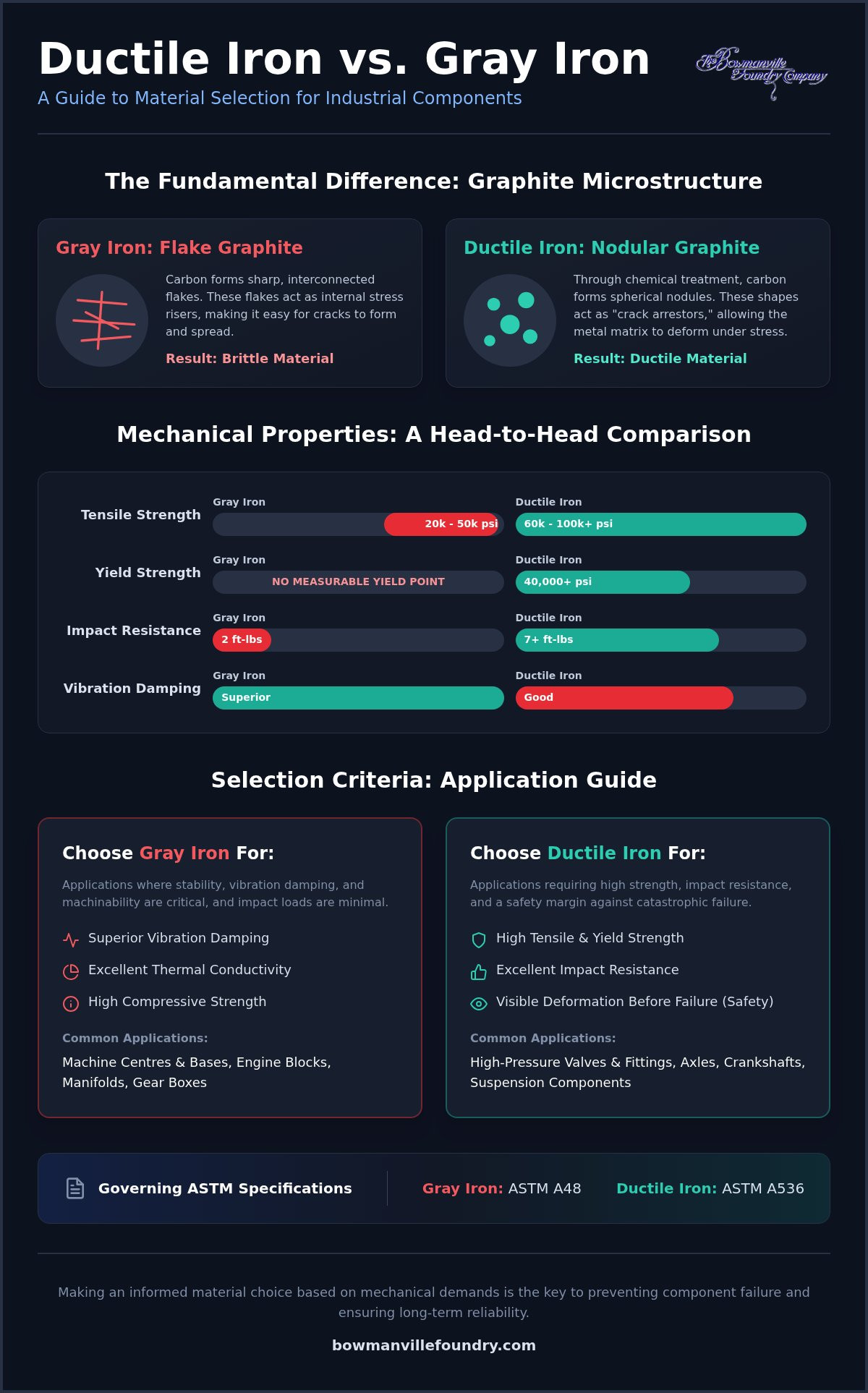
The primary distinction lies in how graphite precipitates during the cooling process. In gray iron, the carbon forms thin, interconnected flakes. In ductile iron, a specific chemical treatment forces that same carbon into spherical nodules. This geometric shift fundamentally alters how the iron matrix handles internal tension and external loads.
The Metallurgy of Gray Iron: Why Flakes Matter
Gray cast iron is defined by its flake-like graphite structure. These flakes are distributed throughout the metal, providing the material with its signature grey appearance when fractured. From a functional standpoint, these flakes offer excellent thermal conductivity and superior vibration damping. They act as a network that can effectively dissipate heat and sound energy.
However, these flakes also act as internal stress risers. Because the edges of the flakes are sharp, they concentrate stress at their tips, making it very easy for cracks to initiate and spread through the matrix. This explains why gray iron is naturally brittle. It lacks a measurable yield strength; once the load exceeds the tensile limit, the material snaps without warning.
The Innovation of Ductile Iron: Nodular Graphite
The development of Ductile iron, often referred to as spheroidal graphite (SG) iron, represents a significant leap in metallurgical engineering. By introducing a controlled amount of magnesium into the molten iron, foundries can realize a nodular structure. The magnesium reacts with the sulphur and oxygen in the melt, allowing the graphite to grow into spheres rather than flakes.
This nodular shape is the key to the material’s namesake ductility. Unlike sharp flakes, spherical nodules do not concentrate stress. Instead, they act as “crack arrestors.” When the metal is subjected to high tension, the iron matrix can flow around these spheres. This allows the component to bend or stretch before failing, providing a safety margin similar to that of structural steel. When comparing ductile iron vs gray iron, this ability to withstand impact and deformation is often the deciding factor for safety-critical parts.
Ductile iron typically offers a minimum tensile strength of 60,000 psi and a yield strength of 40,000 psi. These figures are significantly higher than the standard 20,000 to 50,000 psi tensile range found in gray iron classes, which possess no yield point at all.
Mechanical Properties: Strength, Ductility, and Vibration Damping
Understanding the mechanical limitations of your material is the most effective way to prevent component failure. While the microstructure determines how the iron behaves internally, the mechanical properties define how the part performs under the rigours of industrial service. When evaluating ductile iron vs gray iron, the primary trade-off involves balancing the need for tensile strength against the requirement for vibration management.
Tensile and Yield Strength Comparison
Ductile iron is engineered for strength. It typically offers a minimum tensile strength of 60,000 psi, with some specialized grades exceeding 100,000 psi. This allows it to rival the performance of many carbon steels. Perhaps more importantly, ductile iron provides a measurable yield strength, usually starting at 40,000 psi. Yield strength is the specific stress point where a material begins to experience permanent deformation. Because gray iron lacks this property, it provides no warning before a catastrophic fracture occurs.
In high-stress environments, impact resistance is equally vital. Data suggests that ductile iron can withstand a minimum of 7 foot-pounds of impact energy, whereas gray iron typically fails at just 2 foot-pounds. For Canadian procurement officers, this difference often justifies the slightly higher material cost. If you’re currently drafting specifications for a high-load project, reviewing a casting buyer’s guide can help you align these strength ratings with your budget constraints.
Damping Capacity and Thermal Conductivity
Gray iron remains the industry standard for stability. Its flake graphite structure allows it to absorb mechanical energy and vibrations more efficiently than any other ferrous metal. This damping capacity is roughly 5 to 25 times greater than that of steel or ductile iron. It’s why gray iron is the logical choice for machine tool bases, engine blocks, and brake components. If a component vibrates excessively, it can lead to precision errors or premature wear in connected parts.
Thermal management is another area where gray iron excels. The interconnected flakes provide a direct path for heat to travel through the metal. This high thermal conductivity prevents hot spots and reduces the risk of thermal warping. While ductile iron is stronger, its nodular graphite structure inhibits heat transfer, making it less suitable for applications where rapid heat dissipation is the priority. Choosing the correct iron is about identifying whether your application demands the resilience of a spring or the stillness of a stone.
Both materials offer excellent wear resistance, particularly when the surface is hardened through post-processing. Gray iron has a slight advantage in “dry” wear scenarios because the graphite flakes act as a self-lubricating agent. However, for gears and brackets subjected to heavy friction and high loads, the superior toughness of ductile iron usually makes it the more durable long-term solution.
Ductile Iron vs. Gray Iron: A Side-by-Side Comparison
Selecting the correct material requires a precise understanding of industry standards and how they translate to field performance. For most Canadian engineering projects, the decision between ductile iron vs gray iron is governed by specific ASTM classifications. Gray iron is categorized under ASTM A48, where the class number directly represents the minimum tensile strength in ksi. Ductile iron follows ASTM A536, which utilizes a three-number grade system to define tensile strength, yield strength, and elongation percentage.
Technical Specification Table
The following table provides a direct comparison of the most common grades used in industrial casting. For a more granular analysis of specific alloy additives and their effects on performance, you can refer to our casting buyer’s guide.
| Property | Gray Iron (Class 30) | Ductile Iron (65-45-12) |
|---|---|---|
| Tensile Strength (min) | 30,000 psi | 65,000 psi |
| Yield Strength (min) | Not Measured | 45,000 psi |
| Elongation (Ductility) | <1% | 12% |
| Vibration Damping | Excellent | Moderate |
| Relative Machinability | 100% (Baseline) | 80-90% |
Impact of Material Choice on Project Budget
When evaluating the cost of ductile iron vs gray iron, it’s vital to look beyond the initial price per pound. Ductile iron typically carries a price premium of 15% to 25% because the nodulizing process requires specialized magnesium treatments and tighter metallurgical controls. As of August 2026, Canadian material surcharges remain at approximately $0.53 CAD per pound for both iron types, reflecting the volatility of raw scrap and energy markets.
However, the superior strength-to-weight ratio of ductile iron often allows for significant cost offsets through design optimization. Because the material is stronger, engineers can specify thinner wall sections and lighter geometries without compromising safety. This reduction in total casting weight can lower shipping costs and reduce the volume of metal required, sometimes making the final component price comparable to a heavier gray iron alternative.
Long-term durability in harsh Canadian climates also plays a role in lifecycle value. While both materials offer respectable corrosion resistance, ductile iron is far less likely to suffer from brittle fracture during extreme freeze-thaw cycles. Choosing a cheaper material that fails in sub-zero temperatures leads to expensive field replacements and downtime. A strategic selection focuses on the total cost of ownership rather than the lowest bid at the foundry gate.
Selection Criteria for High-Stress vs. High-Stability Applications
The debate of ductile iron vs gray iron is ultimately resolved by the functional environment of the final part. Engineers must determine if the priority is stillness and thermal transfer or resilience and load-bearing capacity. Choosing the wrong grade based on initial cost alone often results in premature component failure or unnecessary machining expenses. A pragmatic selection process evaluates the specific stresses, vibration profiles, and environmental factors the part will encounter during its lifecycle.
Case Studies in High-Stability Engineering
Gray iron is the gold standard for applications where dimensional stability and vibration management are non-negotiable. In machine centres and engine blocks, the material must resist warping while absorbing the harmonic energy generated by high-speed moving parts. Its high thermal conductivity also prevents localized heat buildup, which is critical for brake drums and industrial heating components. This ability to dissipate heat quickly protects the integrity of the iron matrix and prevents the component from distorting under load.
You can explore more grey iron casting applications to see how these properties translate into specific industrial designs across North America. For projects requiring precision alignment, the stillness of gray iron is an engineering necessity that ductile alternatives cannot replicate.
Engineering for High-Stress and Safety-Critical Parts
When a component faces sudden shocks, high internal pressures, or structural tension, the brittleness of gray iron becomes a significant liability. Ductile iron is the mandatory specification for brackets, gears, and high-pressure valves because it can deform without fracturing. This safety margin is essential for structural hardware where a failure could lead to a total system collapse. Because ductile iron behaves more like steel under tension, it provides a reliable yield point that allows for safer operation in high-risk environments.
Accessing expert ductile iron foundry services ensures that the casting process is calibrated to meet these rigorous safety standards. For specific thin-walled components that require a balance of ductility and excellent machinability, malleable iron remains a versatile alternative that bridges the gap between these two materials.
Environmental stressors, particularly the extreme thermal cycling common in Canada, also dictate material choice. While gray iron handles steady heat well, it can crack under rapid temperature shifts if the geometry is complex. Ductile iron’s toughness provides better resistance to these freeze-thaw cycles and sudden impact loading. If you’re ready to specify the right material for your next project, contact us at Bowmanville Foundry to discuss your custom engineering requirements.
Optimizing Your Casting Project with Professional Foundry Services
The technical decision between ductile iron vs gray iron is only the first step in a successful procurement cycle. Once the appropriate grade is selected, the focus must shift to how the raw casting is transformed into a finished component. Utilizing integrated iron casting and machining services is a pragmatic way to reduce lead times and eliminate the logistical friction of managing multiple vendors. When the foundry handles the machining, they assume full responsibility for the dimensional accuracy of the final part, ensuring that any internal casting defects are identified before the component reaches your assembly line.
The Value of Post-Processing and Finishing
Post-processing also involves critical surface treatments and metallurgical enhancements. In the Canadian climate, where humidity and temperature fluctuations during storage can lead to rapid oxidation, applying appropriate surface coatings is a standard preventive measure. Additionally, specific heat treating protocols can be employed to refine the properties of either material. For instance, annealing can improve the machinability of gray iron, while quench and temper processes can significantly increase the hardness and wear resistance of ductile iron components.
These finishing services ensure that your components arrive ready for immediate installation. By consolidating casting, heat treating, and machining under one roof, you realize a more steady and predictable production schedule. This methodical approach minimizes the risk of damage during transport between different service providers and maintains a high level of technical mastery over the entire manufacturing process.
Collaborating with a Trusted Canadian Foundry
Success in heavy manufacturing relies on transparency and early-stage engineering collaboration. By engaging with foundry experts during the design phase, you can identify potential flaws that might lead to casting failures or excessive material waste. This proactive approach is central to optimizing custom iron casting production. A foundry with deep institutional knowledge acts as a mentor, guiding you through the nuances of pattern design, gating systems, and alloy selection.
This collaboration also extends to quality control. Professional foundries utilize rigorous testing standards, including chemical analysis and non-destructive testing, to ensure every component meets the required ASTM specifications. To assist in your decision-making process, we encourage you to download our free casting buyer’s guide. This resource provides a comprehensive path from initial curiosity to technical certainty, helping you master the variables involved in ductile iron vs gray iron selection for your next industrial project.
Advancing Your Industrial Casting Strategy
Successful material selection is not about finding the “best” iron, but rather identifying the most appropriate graphite morphology for your specific stress profile. You now understand that the strategic choice of ductile iron vs gray iron dictates whether a component will absorb vibrations or withstand sudden impacts. While gray iron remains the standard for thermal conductivity and stability, the nodularity of ductile iron allows for lighter, stronger designs that can reduce overall manufacturing costs through weight optimization.
Since 1902, we’ve focused on providing the expert technical data and integrated post-processing services required to turn these metallurgical principles into high-performance components. Our facility offers comprehensive machining and finishing to ensure your castings meet the most rigorous ASTM standards. To refine your selection process and avoid the high costs of component failure, we invite you to Download Your Free Iron Casting Buyer’s Guide. Correct grade specification is the first step toward long-term mechanical reliability, and we look forward to supporting your next engineering challenge with technical mastery and dependable craftsmanship.
Frequently Asked Questions
Is ductile iron stronger than gray iron?
Yes, ductile iron is significantly stronger than gray iron. It possesses a minimum tensile strength of 60,000 psi and a minimum yield strength of 40,000 psi. In comparison, gray iron has no measurable yield strength and its tensile strength typically ranges between 20,000 and 60,000 psi. This makes ductile iron the preferred choice for safety-critical components that must withstand high stress or sudden impact without experiencing a catastrophic fracture.
Why is gray iron better for damping vibration than ductile iron?
Gray iron is superior for damping vibration because of its internal flake graphite structure. These flakes act as a network that effectively dissipates mechanical energy and sound. This damping capacity is roughly 5 to 25 times greater than that of steel or ductile iron. It’s the primary reason why gray iron remains the industry standard for machine tool bases, engine blocks, and any application where stillness is vital for precision.
Can ductile iron be used as a direct replacement for gray iron?
Ductile iron cannot always be used as a direct replacement for gray iron without design adjustments. While it’s stronger, it lacks the same vibration damping and thermal conductivity properties. If you substitute gray iron with ductile iron in a machine base, the increased vibration could lead to precision errors. However, the superior strength of ductile iron often allows you to design lighter parts with thinner walls, which can optimize your manufacturing costs.
What is the cost difference between ductile and gray iron castings?
Ductile iron is typically 15% to 25% more expensive than gray iron. This price difference is due to the additional nodulizing treatment, which requires magnesium and tighter metallurgical controls. While the initial material cost is higher, the total lifecycle value often favours ductile iron in high-stress environments. By using a stronger material, you can reduce the frequency of part replacements and potentially lower shipping costs by designing lighter, more efficient components.
How does the machinability of ductile iron compare to gray iron?
Gray iron generally offers better machinability than ductile iron. The graphite flakes in gray iron act as a natural lubricant and help to break up chips during the cutting process, which reduces tool wear. Ductile iron is still quite machinable, but its higher strength and toughness require more energy and can lead to faster tool degradation. Foundries often use specialized heat treatments to improve the machining characteristics of both iron types.
Which iron grade is best for high-temperature applications?
Gray iron is often preferred for high-temperature applications that require excellent thermal conductivity and resistance to warping. The flake structure provides a more direct path for heat to travel through the metal, preventing localized hot spots. However, if the application involves rapid thermal cycling or high mechanical stress at elevated temperatures, ductile iron may be the better choice. Its superior toughness helps it resist cracking during the expansion and contraction phases.
What are the most common ASTM standards for ductile and gray iron?
The most common standards used in the industry are ASTM A48 and ASTM A536. ASTM A48 covers gray iron castings and uses a class system where the number represents the minimum tensile strength in thousands of pounds per square inch. ASTM A536 is the standard for ductile iron, utilizing a three-number grade system. These numbers represent the minimum tensile strength, yield strength, and the percentage of elongation, providing a comprehensive profile of the material’s performance.
Does ductile iron rust more easily than gray iron?
Ductile iron and gray iron have similar corrosion resistance, but they react differently to oxidation. Both materials will develop a protective layer of rust on the surface when exposed to the elements. Gray iron’s flake structure can sometimes lead to deeper pitting over long periods. Because Canadian industrial environments often involve significant moisture and salt, we recommend applying surface coatings to both ductile iron vs gray iron components to ensure long-term durability.
