
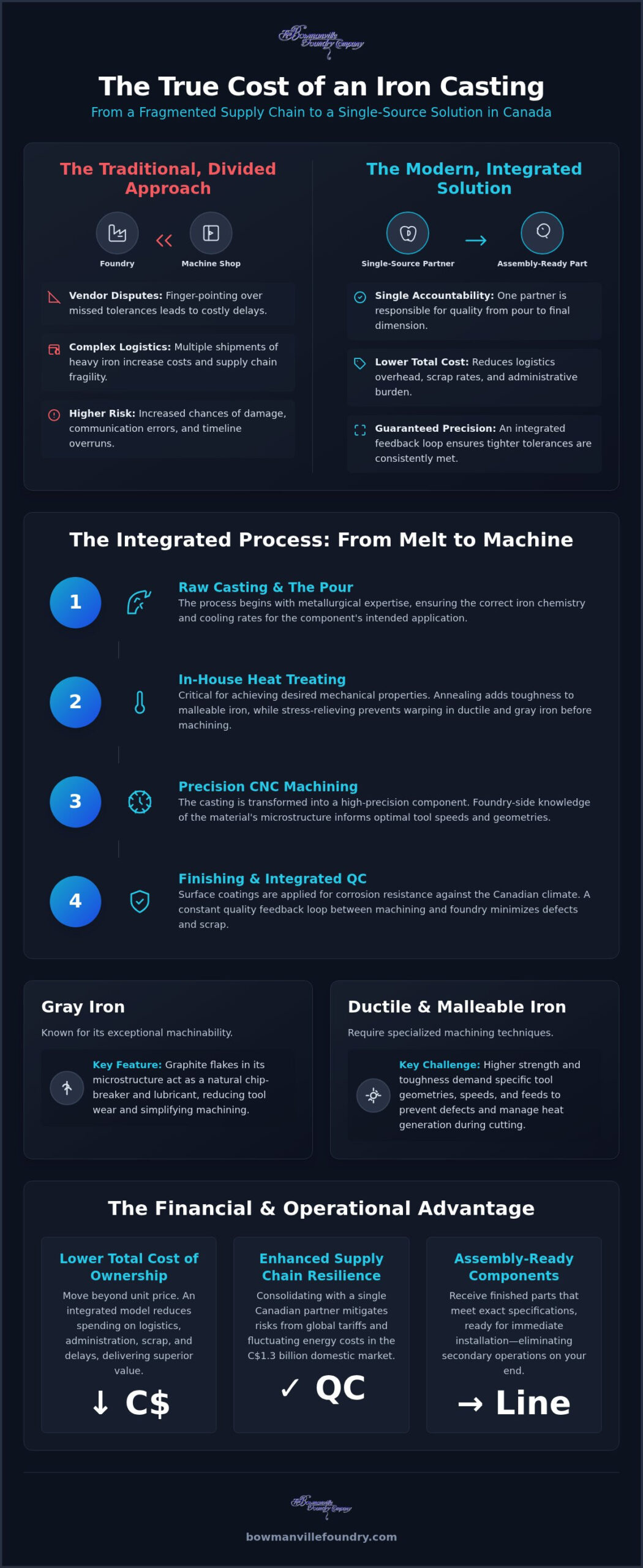
The most expensive iron casting isn’t the one with the highest unit price; it’s the one that sits on a transport truck for weeks while two separate vendors argue over who’s responsible for a missed tolerance. When you split your procurement between a foundry and a machine shop, you aren’t just doubling your paperwork. You’re introducing significant risks to your timeline and your bottom line. You’ve likely experienced the logistical headaches and the rising shipping costs associated with moving heavy iron multiple times across the country, especially as new tariffs and energy costs continue to fluctuate in the C$1.3 billion Canadian ferrous metal market.
We understand that your primary goal is a reliable supply of parts that meet exact specifications without the finger-pointing. This guide demonstrates how choosing integrated iron casting and machining in Canada can fundamentally simplify your operations. You’ll learn how consolidating these processes ensures metallurgical integrity and delivers ready-to-use components directly to your assembly line. We’ll examine the technical advantages of a single-source partner and show you how to lower your total cost of ownership through reduced logistics and guaranteed precision.
Key Takeaways
- Discover how combining foundry operations with CNC machining transforms raw castings into high-precision, assembly-ready components.
- Understand the critical role of post-processing, including heat treating, in achieving the specific mechanical properties required for malleable and ductile iron parts.
- Streamline your supply chain by leveraging integrated iron casting and machining Canada, effectively eliminating the logistical delays and costs of multiple vendors.
- Learn how integrated quality control creates a feedback loop between the machine shop and the foundry to ensure tighter tolerances and reduced scrap rates.
- Gain actionable insights on how to evaluate a foundry’s integrated capabilities during the RFP process to lower your total cost of ownership.
Defining Integrated Iron Casting and Machining Services
Integrated manufacturing in the iron industry represents a fundamental shift from traditional foundry operations toward a more sophisticated, engineered approach. In the past, a foundry’s responsibility ended when the cooled part left the sand. Today, Casting (metalworking) is only the beginning of the value chain. Integrated iron casting and machining Canada provides a seamless transition where the raw pour is immediately followed by secondary CNC machining. This model combines traditional metallurgical expertise with modern precision to deliver components that are ready for immediate installation on the assembly line.
Canadian manufacturers are increasingly moving toward this vertical model to combat supply chain volatility. With a C$1.3 billion market size in 2026, the domestic industry is under pressure from energy costs and global tariffs. By consolidating services, firms reduce the logistical risks of moving heavy iron multiple times between different vendors. There’s also a vital distinction between basic cleanup, such as grinding and deburring, and precision post-processing. While cleanup ensures a part is safe to handle, precision machining ensures it meets the exact tolerances required for high-performance industrial applications.
The Concept of Vertically Integrated Production
Vertically integrated production eliminates the traditional communication gap between design engineers and the machine shop. When one facility handles both the pour and the finish, there’s a single point of accountability. Adopting integrated iron casting and machining Canada removes the administrative burden of managing separate contracts and prevents the disputes that often occur when a part doesn’t meet specifications. It’s a pragmatic solution for complex industrial projects where lead times are tight and the margin for error is non-existent. This approach ensures that the person cutting the metal understands exactly how it was poured.
Why Iron Grades Require Specialized Machining
The machinability of iron isn’t universal; it depends heavily on the specific grade and its microstructure. Gray iron is known for its excellent machinability due to graphite flakes that act as a natural lubricant. In contrast, ductile and malleable iron require different tool geometries and speeds to handle their higher strength and elongation properties. Foundry-side knowledge is essential here. Because the foundry team understands the cooling rates and alloy compositions used during the pour, they can set machining parameters that minimize tool wear and prevent subsurface defects from being exposed during the final cut. This synergy ensures the integrity of the finished component is never compromised.
Essential Post-Processing for Malleable, Ductile, and Gray Iron
A raw iron casting is rarely a finished engineered component. To function reliably in heavy-duty applications, the metal must undergo a series of transformations that occur after the initial pour. These secondary operations are what turn a shaped piece of iron into a high-performance part. Integrated iron casting and machining Canada allows these critical operations to happen under one roof, ensuring that every post-processing step is informed by the specific chemistry of the melt. This continuity is vital for maintaining the structural integrity of the component throughout its service life.
In-House Heat Treating for Enhanced Durability
Heat treating is the most critical post-processing step for many iron grades. Malleable iron, for example, is inherently brittle after casting and requires an extensive annealing cycle to achieve its signature toughness and ductility. Without this controlled thermal processing, the part wouldn’t be able to withstand significant impact or stress. Similarly, stress-relieving is often necessary for ductile and gray iron to ensure they don’t warp or distort during high-precision machining. Managing this in-house allows for strict adherence to ASTM standards. Outsourcing this process to a third party can be risky; generalist facilities often lack the specialized knowledge required to handle the unique cooling curves of specific iron alloys. For a deeper understanding of how these thermal cycles affect material selection, the comprehensive guide to malleable iron casting Canada provides detailed insight into ASTM A47 grade selection and post-processing requirements.
Surface Coating and Finishing Options
The Canadian climate presents unique challenges for industrial components, ranging from corrosive road salts to extreme humidity. Protecting the iron surface is a necessity, not a luxury. Preparation begins with shot blasting or vibratory finishing to remove foundry scale and create a uniform surface profile. This mechanical cleaning is essential for proper coating adhesion. Once prepared, parts can be finished with industrial paints, plating, or specialized coatings tailored to the end-use environment. Proper surface cleaning at the foundry level is the only way to guarantee that these coatings won’t peel or fail when exposed to the elements.
Integrated iron casting and machining Canada also streamlines the final stages of the supply chain. Providing assembly-ready parts means more than just machining; it involves final deburring, inspection, and even partial assembly of sub-components. We offer “pick and pack” services that allow these finished parts to move directly from our facility to your production line. This eliminates the need for intermediate warehousing and reduces the risk of handling damage. For those refining their procurement strategy, it’s helpful to consult a comprehensive Casting Buyer’s Guide to understand how these finishing options impact total lead times.
Reducing Lead Times and Transportation Costs
Moving heavy iron castings across vast Canadian distances is inherently expensive. Fuel surcharges and specialized freight requirements for oversized loads can quickly erode the margins of a project. Integrated manufacturing eliminates the need for intermediate transport between the foundry and a separate machine shop. This synchronization ensures that production schedules are aligned; the machining team is ready the moment the castings clear the cooling floor. Industry data suggests that optimizing these integrated logistics can save up to 15% on total project costs by eliminating redundant handling and secondary freight charges.
Centralizing Accountability for Final Specifications
One of the most persistent pains in industrial procurement is vendor finger-pointing. If a finished component fails to meet a critical tolerance, the machine shop may blame the casting’s hardness, while the foundry might claim the machining was performed incorrectly. Single-sourcing removes this ambiguity entirely. There is one point of contact and one company responsible for the part’s integrity from the initial ladle to the final micrometer reading. This centralization provides a single warranty covering both the material properties and the dimensional accuracy. For quality-sensitive industries like mining or heavy transport, this simplifies the auditing process and ensures that every component arriving at the assembly line has passed a unified quality gate. It’s a pragmatic way to reduce the administrative burden of managing multiple vendor contracts while securing the metallurgical integrity of your custom iron components.
Ensuring Precision Through Integrated Quality Control
The greatest efficiency gain in integrated iron casting and machining Canada isn’t found in the speed of the machines, but in the intelligence of the inspection process. Machining a casting that contains internal porosity or subsurface inclusions is a waste of both time and expensive tooling. By integrating these departments, the quality control team can perform rigorous checks immediately after the pour. This ensures that only sound material reaches the CNC mill, preventing the scenario where a defect is only discovered after hours of precision work has already been invested.
Identifying Casting Defects Before Secondary Operations
We utilize several non-destructive evaluation (NDE) methods to verify casting soundness before any metal is cut. Pressure testing is essential for fluid-handling components, while ultrasonic inspection allows us to see inside the metal to detect voids that aren’t visible on the surface. Catching these hidden defects early allows the foundry to adjust the gating or pouring temperature in real-time. This feedback loop significantly increases overall yields and ensures that customers don’t pay for the labour spent on defective parts. It’s a proactive approach that prioritizes metallurgical integrity above all else.
Maintaining Tight Tolerances for Industrial Hardware
Achieving dimensional stability requires a deep understanding of how different iron grades behave during the cutting process. Gray iron, with its high graphite content, is exceptionally stable and resistant to warping. Malleable iron, however, undergoes significant thermal changes during its annealing cycle, which can affect its final dimensions. An integrated shop understands these metallurgical nuances. We can adjust the initial casting pattern to account for the specific ways a grade will move during both heat treating and high-precision machining. This level of coordination is the only way to maintain tight tolerances across high-volume production runs. Engineers specifying components for demanding applications should also consider how a specialized ductile iron foundry in Ontario can provide the grade-specific expertise needed to balance tensile strength with machinability requirements.
Consistency is paramount for industrial hardware that must perform in the field for decades. Our 120-year history has taught us that precision is a result of controlled variables at every stage, from the sand mold to the final micrometer check. If you’re looking to optimize your next project and reduce the risk of non-conforming parts, you can request a quote for integrated services to see how our unified quality control process protects your investment. This single-source accountability ensures that your components arrive at the assembly line exactly as engineered, every single time.
Implementing Post-Processing into Your Procurement Strategy
Adopting integrated iron casting and machining Canada isn’t just a technical choice; it’s a strategic procurement decision that requires a shift in how your team evaluates potential partners. Transitioning away from fragmented sourcing involves looking beyond the per-unit cost of a raw casting. The true value of integration lies in the reduction of secondary shipping, the elimination of vendor disputes, and the assurance that the finished part meets every engineering specification. When you consolidate these services, you’re buying a completed component rather than a raw material, which fundamentally changes your risk profile.
Evaluating Foundry Capabilities and Technical Expertise
Evaluating a partner’s ability to deliver finished components requires a thorough audit of their technical infrastructure. You should verify that the facility possesses the specific CNC equipment and tooling necessary for your part’s geometry. It’s equally important to assess their history with specific iron grades. For instance, if your project requires malleable iron casting Canada expertise, ensure the foundry has on-site annealing furnaces and a proven track record of managing the long heat-treating cycles this material demands. Requesting case studies of integrated projects allows you to see how the shop handles the transition from the cooling floor to the machine shop. A dependable partner will be transparent about their in-house capacities versus any outsourced finishing services, providing you with a clear map of the component’s journey through the facility.
Utilizing the Casting Buyer’s Guide for Better Decisions
Technical data is the most effective tool for justifying a move to single-source manufacturing. Selecting the wrong iron grade for a specific post-processing requirement can lead to excessive tool wear or surface finish issues. The right grade balances mechanical performance with machinability to keep total costs low. Understanding the trade-offs between different finishing options, such as shot blasting versus vibratory finishing, is essential for achieving the desired surface profile for your industrial hardware.
While iron casting provides the foundation for heavy machinery, many industrial projects also require high-precision components crafted from sheet metal; for these needs, you can visit Velocity Sheet Metal to learn about their laser cutting and fabrication solutions.
Our institutional knowledge, built over 120 years of operation, is distilled into resources designed to help engineers and procurement officers make informed choices. We encourage you to Download the Free Casting Buyer’s Guide to optimize your next project. This resource provides the frameworks needed to select materials and finishing processes that align with your budget and performance goals. By integrating this guide into your design and procurement workflow, you ensure that every decision is grounded in metallurgical reality and physical craftsmanship.
Securing Long-Term Performance for Iron Components
Reliable industrial procurement requires more than just a successful pour. It demands a unified approach where metallurgical expertise and precision machining work in tandem. By consolidating these processes, you eliminate the logistical delays and accountability gaps that often plague fragmented supply chains. This strategy ensures that every component arriving at your assembly line has undergone rigorous quality control, from the initial melt to the final finish. Whether you require malleable, ductile, or gray iron, the shift toward a vertically integrated model is a pragmatic choice for reducing total cost of ownership and ensuring part integrity.
Since 1902, we’ve specialized in delivering custom engineered iron components that meet the most demanding standards. Our deep institutional knowledge allows us to guide you through the complexities of material selection and post-processing. If you’re ready to simplify your operations, you can Request an Accurate Iron Casting Quote for Your Integrated Project today. For those still in the design phase, our Free Casting Buyer’s Guide is an essential resource for expert grade selection and technical planning. We look forward to helping you realize the full potential of integrated iron casting and machining Canada for your next project.
Frequently Asked Questions
What are the main benefits of integrated iron casting and machining?
The primary benefits include streamlined logistics, single-source accountability, and significantly reduced lead times. This model eliminates the “logistics loop” where heavy components are shipped multiple times between independent vendors. By utilizing integrated iron casting and machining Canada, you ensure that the metallurgical knowledge from the initial pour informs the final CNC cutting process. This synergy leads to higher part integrity and a more dependable supply chain for complex industrial projects.
Can all iron grades be machined with the same level of precision?
No, machinability varies significantly across gray, ductile, and malleable iron grades. Gray iron offers high dimensional stability due to its graphite structure; however, malleable iron requires specialized heat treating to achieve the necessary toughness for precision cuts. Each material responds differently to tool wear and cutting speeds. Grade-specific machining parameters are required to maintain tight tolerances and prevent subsurface defects from affecting the final component’s performance.
How does in-house heat treating affect the lead time of my order?
In-house heat treating reduces total lead times by eliminating the transit days and wait times associated with third-party thermal processors. Since the foundry controls the scheduling of annealing or stress-relieving cycles, parts move immediately from the cooling floor to the furnace. This synchronization prevents the administrative bottlenecks that occur when coordinating between multiple vendors. It ensures that your project stays on schedule without the risk of external delays.
Is it more cost-effective to source machining separately from casting?
Separating these services often results in higher total costs because of redundant shipping fees and increased administrative overhead. While a standalone shop might offer a lower unit price for cutting, the cost of transporting heavy iron castings and the risk of vendor disputes usually outweigh those initial savings. Single-sourcing provides a lower total cost of ownership by centralizing accountability and reducing the risk of non-conforming parts reaching your assembly line.
What types of surface coatings are best for iron castings in Canada?
Industrial paints, plating, and epoxy coatings are the most effective options for protecting iron from Canada’s corrosive climate. Proper surface preparation through shot blasting or vibratory finishing is required at the foundry level to ensure these coatings adhere correctly. The specific choice depends on the end-use application, such as exposure to road salts in transportation or high humidity in underground mining environments where long-term corrosion resistance is paramount.
What is the difference between malleable and ductile iron for machining?
Malleable iron is cast as white iron and must undergo an extensive annealing process to become tough and machinable. Ductile iron contains nodular graphite that provides good machinability directly in the as-cast state for many industrial applications. Malleable iron is often preferred for components requiring thinner wall sections and high impact resistance; conversely, ductile iron is frequently chosen for its high strength-to-weight ratio in larger, complex precision components.
How does Bowmanville Foundry ensure quality control across both services?
We implement a unified quality gate system that includes non-destructive evaluation (NDE) such as ultrasonic testing and pressure testing before machining begins. This ensures that only sound castings reach the mill. Our 120-year history allows us to maintain a feedback loop where machining results are used to fine-tune casting patterns. This collaborative approach ensures dimensional consistency and metallurgical integrity across high-volume production runs for our Canadian clients.
Do integrated services help in preventing common casting defects?
Yes, integrated iron casting and machining Canada helps prevent defects by facilitating real-time communication between the machine shop and the foundry floor. If a CNC operator discovers subsurface porosity during a cut, the foundry team can adjust the gating system or pouring temperature immediately. This proactive response reduces scrap rates and prevents the recurrence of defects in subsequent batches, ensuring that the final engineered components meet all required tolerances.
