
Could a material that costs less than forged steel actually outperform it in Canada’s harshest industrial environments? Many engineers realize that relying on expensive forgings often leads to a cycle of high procurement costs and premature wear in abrasive conditions. You’ve likely felt the pressure to reduce component weight without compromising the structural integrity required for heavy-duty machinery. It’s a difficult balance to maintain when your supply chain involves multiple vendors for casting and post-processing.
This guide explains how austempered ductile iron (ADI) applications provide a high-strength, wear-resistant, and cost-effective alternative to traditional steel. We’ll explore how this material allows for weight reductions of 10-40% while meeting the rigorous ASTM A897/A897M-22 standards. By the end of this article, you’ll understand how to lower your total cost of ownership and simplify logistics by working with a single Canadian technical centre for both your casting and heat-treating requirements.
Key Takeaways
- Understand how the specialized austempering heat-treatment process creates the ausferrite microstructure required for superior mechanical performance.
- Identify high-performance austempered ductile iron (ADI) applications across the heavy equipment and agricultural sectors to replace traditional forged steel.
- Discover how ADI’s lower density allows for 10-40% weight reduction compared to steel, leading to immediate energy savings and lower total cost of ownership.
- Understand the work-hardening characteristics of ADI that provide exceptional wear resistance in abrasive Canadian environments.
- Master critical engineering best practices for wall thickness and fillet design to ensure uniform cooling and maximize component fatigue life.
What is Austempered Ductile Iron (ADI)?
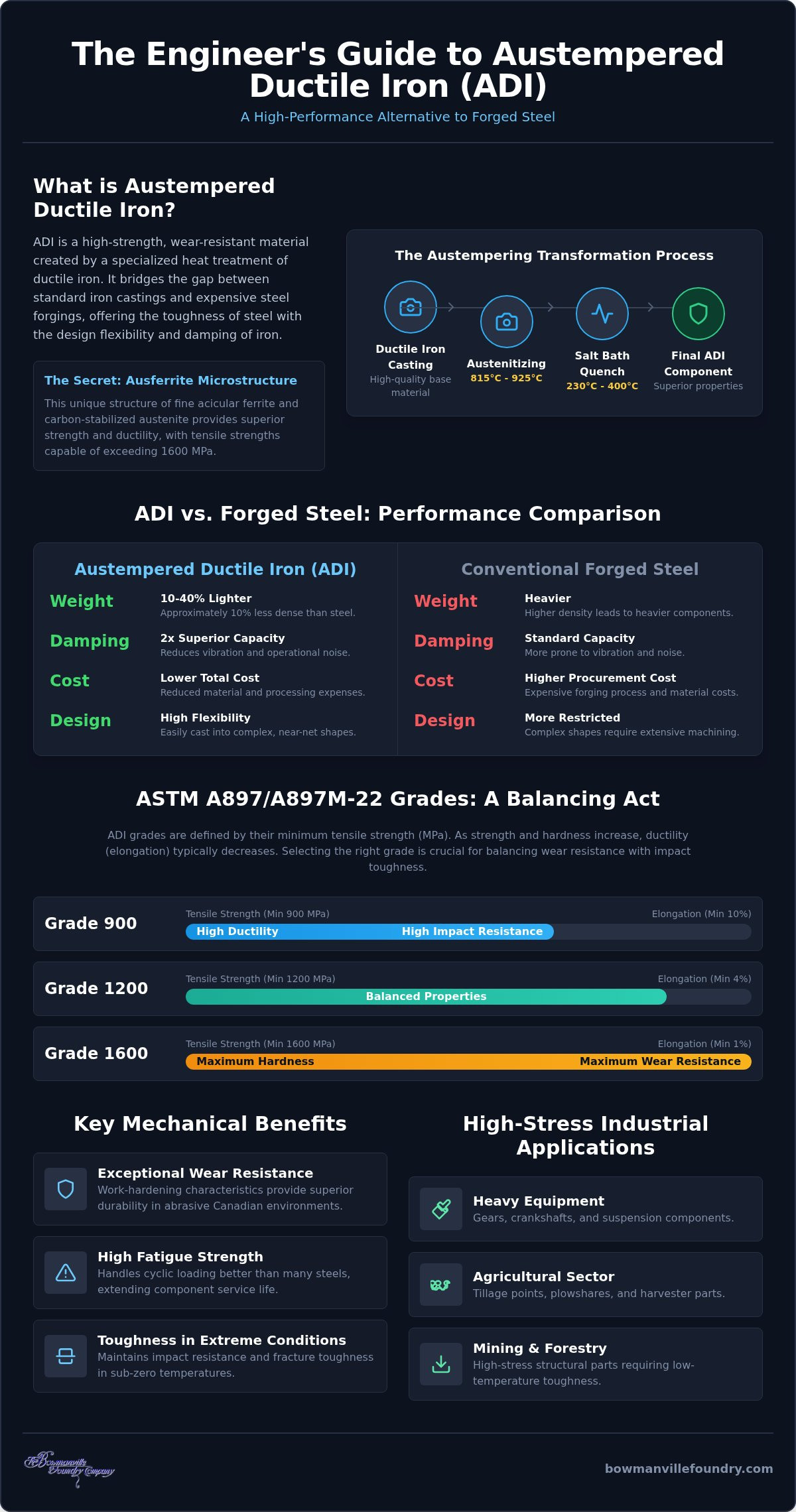
Austempered Ductile Iron (ADI) represents a significant advancement in metallurgical engineering. It’s a high-strength material created by subjecting a specific base of ductile iron material to a rigorous, multi-stage heat-treatment process. This transformation results in a material that functions as a strategic bridge between standard iron castings and expensive steel forgings, making it ideal for various industrial austempered ductile iron (ADI) applications. For many heavy-duty components, ADI provides the toughness of steel with the design flexibility and vibration-damping qualities of cast iron.
The secret to ADI’s performance lies in its unique ausferrite microstructure. Unlike standard ductile iron, which typically contains ferrite and pearlite, ADI consists of fine acicular ferrite and carbon-stabilized austenite. This combination allows the material to achieve tensile strengths exceeding 1600 MPa while maintaining remarkable ductility. Engineers realize that starting with a high-quality base iron is non-negotiable. Any inconsistencies in the graphite nodule count or base chemistry will be magnified during heat treatment. A Canadian technical centre with over a century of expertise understands that the casting’s integrity must be verified before it ever enters the salt bath.
The Austempering Process Explained
The Austempering process begins by heating the casting to an austenitizing temperature, usually between 815°C and 925°C. Once the structure is fully austenitic, the part is rapidly quenched in a molten salt bath. This bath is held at a constant temperature, typically between 230°C and 400°C, to allow for an isothermal transformation. Precise temperature control is vital during this stage. If the temperature fluctuates, brittle pearlite or martensite may form, which compromises the integrity of the component. To ensure deep hardenability in thicker sections, alloying elements like copper, nickel, and molybdenum are added to the melt. Copper and nickel increase the material’s strength, while molybdenum ensures a uniform ausferrite structure throughout heavy sections.
ASTM Standards for ADI Grades
Engineers select ADI based on specific mechanical requirements defined by their grade. Common classifications include Grade 900, 1050, 1200, 1400, and 1600. These numbers represent the minimum tensile strength in megapascals. As the tensile strength increases, the elongation percentage generally decreases. For example, a Grade 900 component offers high ductility and impact resistance, whereas Grade 1600 provides maximum hardness and wear resistance for abrasive environments. The ASTM A897/A897M-22 standard governs the classification and mechanical property requirements of these austempered ductile iron components to ensure consistency across the Canadian supply chain.
Key Mechanical Benefits and Engineering Properties
Austempered Ductile Iron (ADI) provides a suite of mechanical properties that often exceed those of forged or cast steel. One of the most significant advantages is the exceptional strength-to-weight ratio. Because ADI is approximately 10% less dense than steel and possesses higher yield strength per unit of weight, engineers can often reduce component mass by 10-40%. This is a critical factor in modern austempered ductile iron (ADI) applications where fuel efficiency and energy conservation are paramount. By selecting ADI, you can achieve the same structural performance as steel while significantly lowering the overall weight of the assembly.
- High fatigue strength: ADI handles cyclic loading better than many aluminum or steel counterparts, extending the service life of moving parts.
- Superior damping: It offers twice the vibration-damping capacity of steel, which results in quieter machinery operation and reduced harmonic stress on connected components.
- Wear resistance: The material’s unique structure allows it to withstand abrasive environments that would quickly degrade standard iron or steel.
Toughness in Extreme Conditions
Canadian industrial operations frequently take place in sub-zero environments where material brittleness leads to catastrophic failure. ADI maintains its impact resistance and fracture toughness at lower temperatures more effectively than many traditional iron grade selection categories. Its high yield strength ensures that components don’t undergo permanent deformation when subjected to sudden, high-stress loads. This reliability makes it a preferred choice for heavy-duty structural parts in mining and forestry. When parts don’t deform under stress, the entire machine maintains its alignment and operational precision over a longer period.
Work-Hardening and Surface Integrity
A defining characteristic of ADI is the transformation-induced plasticity (TRIP) effect. When the surface is subjected to high contact stress, the retained austenite transforms into martensite. This creates a hard, wear-resistant outer layer while the core remains ductile and tough. According to resources from the Ductile Iron Society, this self-hardening property often eliminates the need for expensive secondary heat treatments like induction hardening or nitriding. For those developing new austempered ductile iron (ADI) applications, these inherent properties simplify the manufacturing process and reduce the number of vendors in the supply chain. You can consult with a technical partner to realize these benefits in your specific designs.
High-Stress Industrial ADI Applications in Canada
Canadian industrial sectors operate in environments that test the absolute limits of material science. From the permafrost of northern mining sites to the abrasive soils of the Prairies, components must withstand extreme thermal cycling and mechanical shock. This is why austempered ductile iron (ADI) applications are becoming the standard for heavy-duty engineering. By utilizing a material that combines high fracture toughness with exceptional wear resistance, Canadian firms can design parts that endure conditions where standard iron or even some steel alloys would fail.
ADI in the Mining and Forestry Sectors
Mining and forestry operations often take place in remote locations where logistical challenges make equipment downtime incredibly costly. In these sectors, ADI is the preferred choice for components exposed to constant rock and timber impact. Common parts include grinding balls, conveyor wear plates, and heavy-duty brackets designed for rugged terrain. One of the most effective strategies involves replacing complex multi-part steel weldments with a single, high-strength ADI casting. This shift eliminates the inherent weaknesses found in heat-affected weld zones and reduces the total number of parts in the assembly. By simplifying the component architecture, operators realize a significant reduction in maintenance intervals and overall downtime in the field.
Agriculture and Heavy Machinery
The agricultural sector has seen a major shift toward ADI for ground-engaging tools such as tillage tools, plowshares, and harvester components. These parts face constant soil abrasion, which can quickly dull or deform lesser materials. The work-hardening surface of ADI ensures these tools maintain their edge longer than standard ductile iron. Weight reduction is another critical factor for large-scale agricultural equipment. Minimizing soil compaction is vital for crop health; because ADI allows for weight savings of up to 40% compared to steel, it’s an ideal choice for large suspension components and boom hinges. Additionally, ADI sprockets and gears offer the performance of steel at a lower production cost, as they’re cast to near-net shape with minimal machining required.
In the railway and transport industries, the demand for reliability and safety is paramount. ADI is frequently used for suspension housings, wheel hubs, and brake components. These parts must handle high cyclic loading and vibration without succumbing to fatigue. The damping properties of ADI contribute to a quieter ride and reduced wear on the surrounding transport infrastructure, making it a versatile solution for Canada’s national transport networks.
ADI vs. Forged Steel: A Performance and Cost Comparison
The decision to specify forged steel or ADI often rests on the total cost of ownership rather than the raw material price alone. While steel forgings are known for high strength, the manufacturing process typically involves significant material waste. Casting ADI to near-net shape minimizes the volume of metal that must be removed during final production. This inherent efficiency is a primary driver for many modern austempered ductile iron (ADI) applications. Because ADI is approximately 10% less dense than steel, it provides immediate weight savings that translate into reduced energy consumption for mobile machinery.
Lead times also favour the foundry process. Sourcing complex steel forgings often involves long wait times for specialized tooling and international shipping. In contrast, a domestic foundry can produce custom iron castings more rapidly, allowing for faster prototyping and production cycles. When you evaluate the combined expenses of material, machining labour, and the specialized heat-treating process, ADI frequently emerges as the more economical solution for high-performance components that require both toughness and precision.
When to Switch from Steel to ADI
Identifying ‘over-engineered’ steel parts is an effective way to optimize your production budget. If a component is currently a complex weldment consisting of three or more steel plates, it’s a prime candidate for conversion. The ‘Rule of Thumb’ suggests that consolidating these assemblies into a single ADI casting eliminates the risk of weld failure and significantly reduces assembly time. Engineers should review the component’s stress profile; if the part demands high fatigue strength and superior wear resistance, ADI will likely meet or exceed the performance of the existing steel design while offering better vibration damping.
Machinability and Post-Processing Trade-offs
Machining ADI requires a strategic approach to balance tool life and dimensional accuracy. The graphite nodules within the iron act as a natural lubricant, which helps reduce friction during the cutting process. Most engineers prefer to perform heavy machining before the austempering heat treatment while the material is still in its ductile state. Precision grinding or light finish machining is then completed post-treatment to achieve exact tolerances.
To streamline your procurement, you can utilize iron casting post-processing services that manage the casting, heat treating, and machining under one roof. Integrating these steps with a single technical partner reduces supply chain complexity and ensures tighter quality control across the entire production run. You can contact a technical expert to determine if your current steel components are suitable for an ADI transition.
Designing for ADI: Engineering Best Practices
Successful austempered ductile iron (ADI) applications begin at the drawing board. While ADI offers superior strength, its design requirements are more stringent than those of standard gray or ductile iron. The most critical factor is how the part geometry reacts during the isothermal quench. If a component features abrupt changes in wall thickness, the cooling rate will vary across the part, potentially leading to residual stresses or an inconsistent ausferrite structure. Engineers must prioritize uniform section thickness to ensure the salt bath quench penetrates the material evenly and reaches the core of the component.
When designing fillets and radii, generous curves are essential. Sharp internal corners act as stress concentrators that can compromise the material’s high fatigue life. By maximizing these radii, you distribute mechanical loads more effectively and reduce the risk of quench-induced cracking. For thicker-walled components, the foundry will adjust the chemical composition, often increasing molybdenum or nickel content to ensure full hardenability. This chemical precision ensures that even the centre of a heavy section achieves the desired mechanical properties without forming brittle phases.
Optimizing Geometry for Heat Treatment
Designers should aim for ‘near-net-shape’ geometry to leverage the cost benefits of ADI. This approach minimizes the need for extensive post-treatment machining, which can be difficult once the material has work-hardened. Avoiding sharp external corners is equally important, as these areas are prone to over-cooling during the quench, which can lead to localized brittleness. By maintaining a consistent thermal mass throughout the part, you realize a more stable and predictable isothermal transformation during the austempering process.
Partnering with a Canadian ADI Specialist
Early collaboration with a technical partner is the most effective way to optimize custom iron casting production. Sourcing your components from a single Canadian facility that handles both casting and post-processing simplifies the logistics and ensures that the heat-treating parameters align perfectly with the base metal chemistry. This integrated approach reduces the risk of casting failure and ensures that your austempered ductile iron (ADI) applications meet the exact ASTM standards required for your industry. Before submitting a quote request, ensure your documentation includes critical tolerance zones and anticipated load profiles to help the foundry select the ideal grade for your specific environment.
Final design checklist for engineers:
- Standardize wall thicknesses to ensure uniform cooling rates.
- Specify generous radii on all internal and external corners.
- Identify areas that require work-hardening for abrasive wear resistance.
- Consult with the foundry regarding the need for specialized alloying in heavy sections.
Optimizing Industrial Components for High-Performance Environments
Transitioning from forged steel to ADI requires a shift in design philosophy, but the rewards are measurable. You’ve seen how the ausferrite microstructure provides the toughness needed for mining and agriculture while reducing total component mass by up to 40%. By prioritizing uniform wall thickness and utilizing integrated post-processing, you can eliminate the logistical headaches of managing multiple vendors. These austempered ductile iron (ADI) applications represent a strategic opportunity to lower your total cost of ownership without compromising on structural safety.
Successful implementation depends on technical mastery and deep institutional knowledge. Since 1902, our technical centre has provided the Canadian national market with the engineering support and technical data required for complex material specifications. Our integrated casting and post-processing capabilities ensure that your components move from the melt through the isothermal quench with absolute precision. Download our Free Casting Buyer’s Guide to find the perfect iron grade for your project. We’re ready to help you realize the full performance potential of your industrial components.
Frequently Asked Questions
What is the difference between ductile iron and austempered ductile iron (ADI)?
ADI is essentially ductile iron that has undergone a specialized isothermal heat treatment. While standard ductile iron is composed of a pearlitic or ferritic matrix, the austempering process creates a unique ausferrite microstructure. This structural change results in nearly double the tensile strength and significantly improved wear resistance. It transforms a reliable base material into a high-performance alternative for the most demanding mechanical environments.
Can ADI replace forged steel in all applications?
While ADI is a powerful alternative, it cannot replace forged steel in every scenario. It’s most effective for components requiring a high strength-to-weight ratio and superior abrasion resistance. However, for parts that require extensive field welding or those subjected to extreme shock loads beyond ADI’s fracture toughness limits, forged steel may remain the appropriate choice. A technical review of the component’s load profile is always the best first step.
How much weight can I save by switching from steel to ADI?
Engineers typically realize weight savings between 10% and 40% when switching from steel to ADI. This reduction occurs because ADI is approximately 10% less dense than steel and possesses a higher yield strength per unit of mass. These savings are vital for mobile machinery where reducing the weight of suspension or drivetrain components leads to improved fuel efficiency and reduced soil compaction in agricultural settings.
Is ADI more difficult to machine than standard cast iron?
Machining ADI presents different challenges than standard cast iron because the material work-hardens under pressure. To optimize tool life, most manufacturers complete heavy machining operations before the austempering process while the iron is still in its ductile state. The graphite nodules within the iron provide natural lubrication during cutting. If post-treatment machining is necessary, specialized tooling and slower speeds are required to manage the increased hardness.
What are the common ASTM grades for ADI components?
The classification of ADI is governed by the ASTM A897/A897M-22 standard. Common grades include 900, 1050, 1200, 1400, and 1600; these numbers reflect the minimum tensile strength in megapascals. Higher grades offer exceptional hardness for abrasive wear, while lower grades prioritize ductility and impact resistance. Selecting the correct grade ensures the component meets the specific fatigue and strength requirements of the intended environment.
Does ADI perform well in extremely cold Canadian climates?
Yes, ADI maintains excellent mechanical properties in sub-zero environments. Its high fracture toughness and impact resistance make it well-suited for northern mining and forestry operations. Unlike some materials that become dangerously brittle in extreme cold, ADI retains its structural integrity. This reliability is why many Canadian austempered ductile iron (ADI) applications are found in heavy equipment operating year-round in the harshest climates across the country.
What industries benefit most from using ADI castings?
The primary sectors utilizing ADI include agriculture, mining, forestry, and heavy transport. These industries rely on the material for ground-engaging tools, suspension housings, and wear-resistant conveyor parts. Because ADI provides the strength of a forging with the vibration-damping qualities of iron, it is ideal for high-stress machinery. These diverse austempered ductile iron (ADI) applications help operators reduce maintenance downtime and lower the total cost of component ownership.
How does the cost of ADI compare to other iron grades?
ADI is generally more expensive than standard ductile or gray iron due to the additional cost of the isothermal heat-treatment process. However, when compared to forged steel, ADI often reduces the total manufacturing cost. This is achieved through near-net-shape casting, which significantly reduces material waste and machining labour. It offers a premium performance profile that justifies the initial investment through improved part longevity and reduced equipment downtime.
