
Selecting the hardest possible material for your machinery often leads to premature brittle failure rather than the longevity you expect. You’ve likely realized that when a critical component fails, the resulting downtime costs far more than the replacement part itself. Finding reliable iron castings for mining equipment that meet strict ASTM standards while maintaining tight tolerances for large-scale components is a constant struggle, particularly when inconsistent material quality from offshore sources compromises your heavy-duty operations.
This article examines how specialized ductile, malleable, and gray iron grades are engineered to withstand extreme geological stressors through precise metallurgical control and custom engineering. We’ll outline the specific material properties that reduce maintenance cycles and explain how integrated post-processing, such as heat treating and machining, ensures components arrive ready for the field. By focusing on the relationship between iron microstructure and mechanical performance, you can secure the technical certainty required for reliable mineral processing. We will also explore how a dependable Canadian partnership can help you achieve long-term equipment durability through technical mastery and established industrial expertise.
Key Takeaways
- Learn how to match specific iron microstructures to geological stressors to prevent brittle failure and extend the service life of high-impact components.
- Understand the technical differences between malleable, ductile, and gray iron castings for mining equipment to ensure your machinery meets rigorous ASTM standards.
- Discover why integrated post-processing services, including heat treating and precision machining, are essential for achieving the tight tolerances required in mineral processing.
- Identify high-failure zones in both surface and underground machinery to optimize your maintenance cycles through better material selection.
- Realize the logistical and quality advantages of partnering with a domestic Canadian foundry that provides comprehensive, ready-to-use components through integrated manufacturing.
The Role of Ferrous Castings in Modern Mining Operations
Iron castings for mining equipment serve as the backbone of heavy-duty extraction and processing machinery. The Role of Ferrous Castings in modern mining is defined by the transformation of molten alloys into intricate, high-mass components such as crusher frames, mill liners, and heavy gearboxes. While fabricated steel structures are common in lighter applications, specialized iron grades are essential for environments where extreme vibration and constant abrasive contact are the norm. The ability to tailor the iron’s microstructure allows engineers to solve specific mechanical challenges that standard materials cannot address.
Choosing iron over steel for complex mining geometries provides clear economic and functional advantages. Iron’s fluidity during the casting process allows for the creation of intricate internal cavities and varying wall thicknesses in a single pour. This reduces the need for extensive welding or secondary assembly, which are often the primary points of failure in high-stress mining environments. By utilizing custom engineering, foundries can optimize these designs to reduce the total cost of ownership through improved component longevity and simplified maintenance. This approach centres on durability rather than just initial purchase price.
Vibration Damping and Wear Resistance
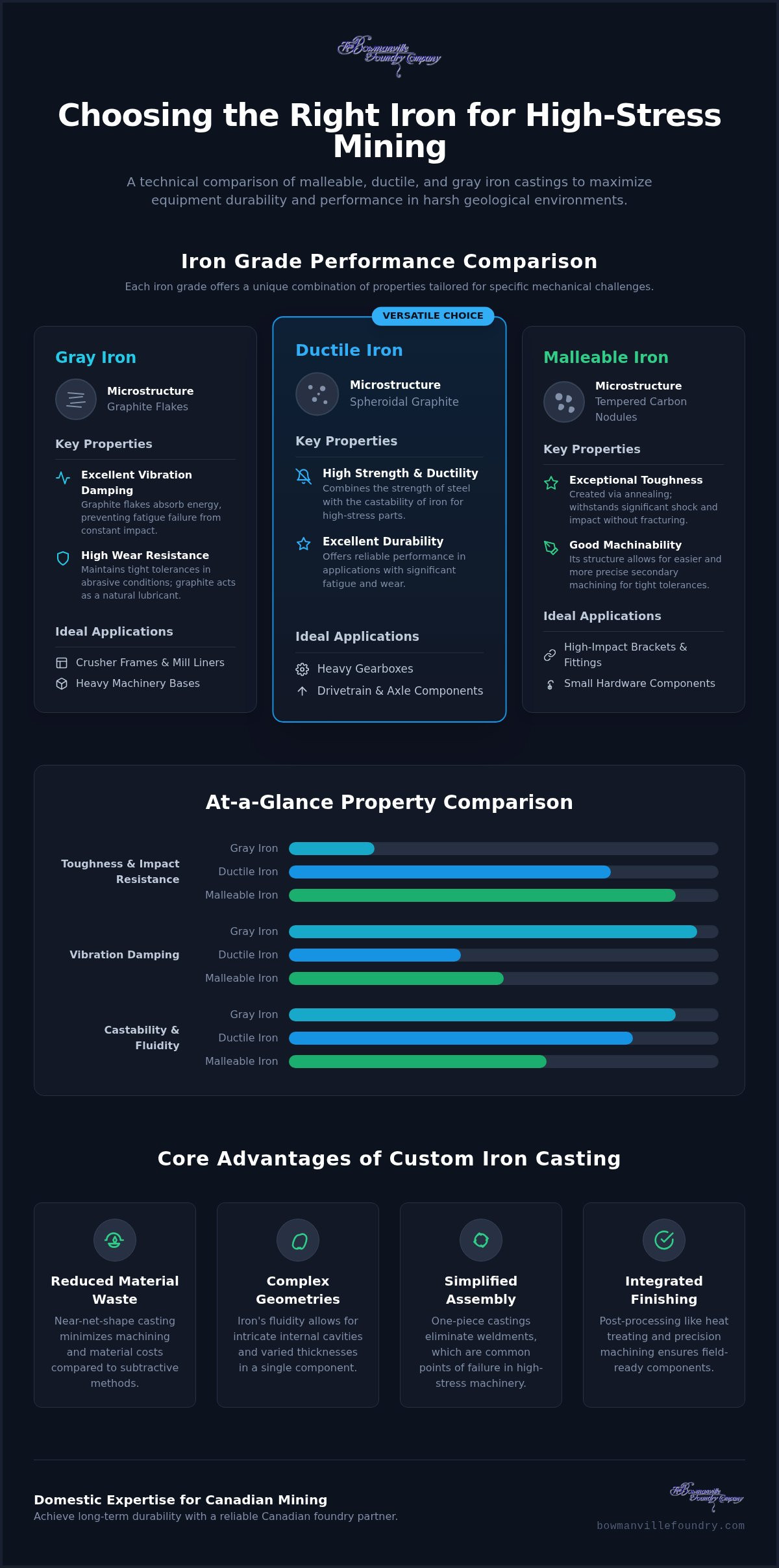
Gray iron is highly effective for vibration damping in heavy machinery. Its internal graphite flakes absorb energy, which prevents the transmission of harmful vibrations through the drivetrain. This characteristic is vital for crushing and grinding equipment where constant impact could otherwise lead to rapid fatigue failure. In abrasive underground settings, the wear resistance of iron castings helps maintain tight tolerances over longer periods, ensuring the equipment operates at peak efficiency without frequent intervention. The graphite acts as a natural lubricant in some applications, further reducing the rate of surface degradation during metal-on-metal contact.
Cost-Effectiveness in Large-Scale Production
Producing near-net-shape parts is a primary driver of cost-efficiency in mining component manufacturing. Casting allows for the production of parts that require minimal secondary machining, which significantly lowers material waste compared to subtractive manufacturing from solid billets. When managing fleet-wide updates, the scalability of the casting process ensures that every replacement part meets the same rigorous specifications. This consistency is crucial for maintaining operational safety and performance standards across a national mining infrastructure.
- Reduced Material Waste: Casting uses only the metal necessary for the part, unlike machining from solid stock.
- Design Flexibility: Engineers can place strength exactly where it’s needed without adding unnecessary weight.
- Simplified Assembly: One-piece castings replace multi-part weldments, reducing labour and inspection costs.
By integrating iron castings for mining equipment into the design phase, operators can achieve a balance of performance and fiscal responsibility that is difficult to match with other manufacturing methods.
Comparing Iron Grades for Mining: Malleable, Ductile, and Gray Iron
Selecting the correct material for subsurface or surface extraction requires a deep understanding of metallurgy. When Comparing Iron Grades, engineers must weigh the trade-offs between hardness, ductility, and vibration absorption. The performance of iron castings for mining equipment is largely determined by the cooling rate during solidification and the subsequent heat treatment protocols. While some components require extreme hardness, most critical mining machinery relies on the specialized properties of malleable, ductile, or gray iron to survive high-impact or high-abrasion environments.
Malleable Iron for Impact Resistance
Malleable iron begins as white iron, which is then subjected to a prolonged annealing process. This thermal treatment transforms brittle iron carbides into small, irregular nodules of tempered carbon. The result is a material that offers exceptional toughness and can withstand significant shock without fracturing. It’s particularly well-suited for brackets, pipe fittings, and small hardware components that experience constant jarring. For a deeper look at these properties, consult The Comprehensive Guide to Malleable Iron Casting in Canada.
Ductile Iron for High-Stress Structural Components
Ductile iron is often chosen for mining frames and heavy-duty supports because it provides steel-like strength with the superior castability of iron. By adding magnesium to the molten metal, the graphite forms into spheres rather than flakes. This nodular structure prevents crack propagation, allowing for high yield strength and significant elongation. When components have larger cross-sections that would be difficult to anneal properly as malleable iron, ductile iron is the preferred choice. Our Professional Guide to Ductile Iron Foundry Services in Ontario provides specific data for these high-stress applications.
Gray Iron for Maximum Damping and Thermal Stability
Gray iron remains a staple for heavy gear housings and engine blocks due to its unique flake graphite structure. These flakes provide the best vibration damping capacity of any ferrous material, which protects sensitive internal components from mechanical resonance. Additionally, gray iron’s high thermal conductivity helps dissipate heat in friction-heavy environments. You can learn more about these use cases in Grey Iron Casting Applications for Canadian Industry.
Understanding these distinctions is the first step toward reducing maintenance cycles. If you’re currently evaluating materials for a new project, our technical team can help you navigate these choices to ensure your iron castings for mining equipment are optimized for the field.
Critical Mining Components and Their Material Requirements
High-failure zones in mining machinery are typically found where components interface with the raw geological environment or where power is transferred through high-torque systems. In these areas, iron castings for mining equipment must be engineered to withstand specific mechanical loads that vary significantly between underground and surface operations. Underground machinery often faces corrosive groundwater and confined space constraints, requiring compact, high-strength designs that prioritize safety. Surface equipment, meanwhile, must endure extreme temperature fluctuations and massive structural loads. By prioritizing design for manufacturability, engineers can create components that optimize the weight-to-strength ratio, ensuring that every kilogram of material contributes to the part’s structural integrity. This methodical approach to material selection reduces the frequency of maintenance cycles and prevents the costly unplanned downtime that plagues mining operations.
Brackets, Mounts, and Suspension Parts
Suspension and mounting systems are subject to relentless vibration and shock. Using malleable iron or ductile iron for these parts provides the necessary toughness to prevent brittle fracture, especially in northern Canadian mining sites where temperatures can drop below -40 degrees Celsius. In these conditions, standard materials often become prone to sudden failure under heavy shock loads. Custom iron casting allows for the production of specialized drilling rig components that incorporate reinforced mounting points and integrated vibration-damping geometries. This engineering approach ensures that brackets don’t just hold a component in place but actively contribute to the machinery’s overall fatigue resistance. It’s a matter of choosing a material that behaves predictably under both static and dynamic loads in the field.
Gear Housings and Transmission Cases
Precision gear systems require housings that maintain absolute dimensional stability under load. Gray iron is the preferred material for these cases because its low thermal expansion and high damping capacity minimize noise and protect gear alignment from mechanical resonance. Advanced molding techniques are used to ensure oil-tight integrity, preventing leaks that could lead to catastrophic drivetrain failure. The process of custom iron casting production allows for the integration of internal cooling fins and complex oil galleries directly into the housing. This eliminates the need for external plumbing and reduces the number of potential leak points. These design improvements are essential for maintaining equipment uptime in remote locations where on-site repairs are difficult. Reliability in these components begins with a precise understanding of how the iron will behave during the solidification process.
Post-Processing and Quality Standards for Mining Castings
The raw state of a component after it leaves the mold, known as “as-cast,” is rarely sufficient for the high-precision requirements of modern extraction sites. While the casting process establishes the primary geometry, it’s the subsequent metallurgical and mechanical refinements that ensure iron castings for mining equipment meet rigorous safety benchmarks. Adherence to specific ASTM standards is not optional in this sector. For instance, malleable iron must comply with ASTM A47, while ductile and gray iron grades are governed by ASTM A536 and A48 respectively. These standards dictate the minimum tensile strength, yield strength, and elongation properties required to prevent catastrophic failure in the field.
Heat Treating for Hardness and Ductility
Heat treating is a critical step that alters the physical and sometimes chemical properties of the metal. For many mining components, annealing is used to relieve internal stresses and improve ductility. Normalizing and quenching processes further refine the grain structure to enhance hardness and wear resistance. This is particularly important for preventing surface spalling, where the metal flakes off under constant abrasive pressure. In the production of malleable iron, a specialized annealing cycle facilitates the metallurgical transformation from brittle white iron to a tough, impact-resistant material. This controlled cooling and reheating phase is what gives the iron its dependable mechanical profile.
Machining and Surface Finishing
Even the largest mining components require critical tolerances where they mate with other parts of the assembly. Precision machining ensures that bearing seats, gear interfaces, and mounting surfaces are perfectly aligned to prevent premature wear in high-load iron castings for mining equipment. Additionally, wet underground conditions necessitate advanced surface finishing and coatings to inhibit corrosion and oxidation. Sourcing these services from a single provider reduces logistical complexity and ensures that quality standards are maintained throughout the entire production cycle. You can learn more about these combined services in our guide to Integrated Iron Casting and Machining in Canada.
By managing both the foundry work and the finishing in-house, we eliminate the risk of communication gaps between separate vendors. This “one-stop-shop” capability ensures that your components arrive on-site ready for immediate installation. If you’re looking to streamline your procurement process, contact our engineering team to discuss your specific post-processing requirements.
Custom Iron Casting Production for the Canadian Mining Sector
The strategic advantage of partnering with a domestic foundry becomes clear when projects require immediate technical alignment and logistical certainty. For the Canadian mining sector, iron castings for mining equipment must be produced within a framework that understands both the national regulatory standards and the harsh environmental realities of the North. Bowmanville Foundry has supported this national infrastructure since 1902, providing a localized source for finished, ready-to-use components. Moving from a technical inquiry to a finished casting is a methodical process that prioritizes accuracy, ensuring that the final part meets every engineering specification. This localized approach ensures that we can provide the technical data and material selection support necessary for complex industrial use, acting as a steady hand through intricate procurement landscapes. We encourage project managers to utilize our technical resources on how to choose iron casting grade to begin the selection process with high-level metallurgical certainty.
Engineering Partnership and Material Selection
A successful casting project is rooted in collaboration. By working directly with our engineering team, you gain access to over a century of institutional casting knowledge. This partnership extends to pattern development and material optimization, where we refine designs to improve castability and field performance. Our legacy as a 120-year-old institution allows us to act as a mentor in the industrial space, sharing wisdom that ensures our clients’ success in even the most demanding environments. Localized manufacturing in Canada significantly reduces lead times compared to international sourcing, allowing for faster responses to site-specific machinery failures. Proximity allows for real-time adjustments and thorough consultations that offshore vendors simply cannot provide. We focus on being a reliable partner that values precision and integrity above all else.
Securing Your Supply Chain
Relying on offshore castings often introduces risks that can compromise mission-critical mining operations. Inconsistent material quality and unpredictable shipping delays lead to prolonged downtime that far outweighs any initial cost savings. Our quality control protocols eliminate these variables, ensuring each part complies with the necessary ASTM standards before it leaves our facility. This commitment to transparency and openness helps you make an informed decision based on technical certainty. By providing extensive documentation and answering detailed inquiries, we position ourselves as a teacher rather than just a vendor. To assist in your procurement process, we provide a free Casting Buyer’s Guide through our technical resource centre. This resource is an essential tool for mining engineers looking to streamline their supply chain and ensure the long-term reliability of their iron castings for mining equipment.
Advancing Mining Reliability Through Technical Mastery
Engineering iron castings for mining equipment requires a precise balance of metallurgical knowledge and physical craftsmanship. By selecting the appropriate iron grade for each component’s specific environment, operators can significantly reduce maintenance cycles and prevent the high costs of unplanned downtime. Utilizing on-site post-processing, such as heat treating and precision machining, ensures that every part meets rigorous ASTM standards and arrives ready for immediate deployment in the field.
Our legacy of expertise since 1902 provides the institutional knowledge required to navigate complex industrial procurement with certainty. We offer comprehensive technical data and detailed Buyer’s Guides to support your material selection process from initial inquiry to final delivery. Partnering with an established Canadian foundry secures your supply chain against the risks of offshore quality variance and logistical delays. If you’re ready to enhance the durability of your machinery, we invite you to Request an Accurate Iron Casting Quote for Your Mining Project. Our team is prepared to help you achieve the technical certainty your operations require.
Frequently Asked Questions
Why is ductile iron often preferred over gray iron for mining equipment?
Ductile iron provides superior tensile strength and elongation because its graphite forms into spheres rather than flakes. This nodular structure prevents crack propagation, which makes it far more resistant to sudden impact than gray iron. It’s the preferred choice for structural frames and high-load components that require steel-like performance. By choosing ductile iron, you gain the durability needed for heavy-duty machinery while benefiting from the castability of iron.
What are the most common ASTM standards for mining iron castings?
Mining components typically adhere to ASTM A536 for ductile iron, ASTM A47 for malleable iron, and ASTM A48 for gray iron. These standards define the mechanical properties, such as tensile strength and yield point, necessary for safety in extreme environments. Compliance ensures the material can withstand the specific pressures of subsurface or surface extraction. Following these industry benchmarks is essential for maintaining operational safety and equipment longevity across the country.
Can malleable iron be used for high-impact mining applications?
Malleable iron is specifically engineered for high-impact and shock resistance through a specialized annealing process. This thermal treatment transforms brittle carbides into tempered carbon nodules, providing the toughness needed for brackets and pipe fittings. It’s an ideal material for smaller components that must endure constant jarring without fracturing in cold weather conditions. This grade ensures that hardware remains dependable even when subjected to the relentless mechanical stress of drilling operations.
How does vibration damping in gray iron benefit heavy machinery?
Gray iron’s flake graphite structure acts as an internal energy absorber, preventing mechanical resonance from damaging sensitive internal parts. This damping capacity is vital for gear housings and engine blocks in crushing equipment where constant vibration occurs. By absorbing these forces, gray iron extends the lifespan of the entire drivetrain and reduces operational noise. Its high thermal conductivity also helps dissipate heat in friction-heavy environments, which is a critical factor for heavy machinery.
What post-processing services are essential for mining components?
Essential post-processing includes precision machining to achieve tight mating tolerances and heat treating to optimize hardness or ductility. Surface finishing and specialized coatings are also critical for preventing corrosion in wet underground environments. Sourcing finished iron castings for mining equipment from a single provider ensures that quality standards are maintained from the initial pour to the final assembly. This integrated approach reduces logistical complexity and guarantees that components arrive on-site ready for immediate use.
How do I choose the right iron grade to prevent casting failure?
Choosing the right grade requires matching the material’s microstructure to the primary stressor, such as impact, abrasion, or vibration. Ductile iron is best for structural loads, while malleable iron excels in shock resistance. Gray iron provides superior damping for housings. Engineers should consult detailed technical data and application guides to make an informed decision. This methodical selection process is the most effective way to prevent casting failure and optimize your equipment’s weight-to-strength ratio.
What are the typical lead times for custom iron casting in Canada?
Lead times vary based on the complexity of pattern development and the volume of the order. Localized Canadian manufacturing typically offers faster turnaround times than offshore sourcing by eliminating international shipping delays and customs hurdles. Working with an established domestic partner allows for real-time adjustments and thorough consultations. This ensures that iron castings for mining equipment are delivered within a predictable schedule, which is crucial for maintaining operational uptime and managing fleet-wide machinery updates.
Is iron casting more cost-effective than steel for mining parts?
Iron casting is often more cost-effective than steel for complex geometries because it allows for near-net-shape production with minimal material waste. Unlike steel fabrications that require extensive welding and assembly, iron can be poured into intricate internal galleries and variable wall thicknesses in a single process. This reduces the total cost of ownership by simplifying the assembly and providing better vibration damping. The casting process also allows for easier scalability when producing large quantities of components.
